


Market Volatility, the Iran Conflict, and the Importance of Staying Invested
When geopolitical tensions escalate, financial markets tend to react quickly. Oil prices spike, stocks wobble, and financial headlines begin speculating about economic fallout. The current conflict involving Iran is no exception. For investors, moments like this can feel unsettling.
Yet history suggests something important: while geopolitical conflicts can create short‑term volatility, their long‑term impact on diversified investment portfolios is often far smaller than investors initially fear. Markets have navigated wars, terrorist attacks, financial crises, and even global pandemics. In many cases, the initial reaction is sharp, but the long‑term trajectory of markets is ultimately driven by economic growth, innovation, and corporate earnings.
How Markets Are Reacting Right Now
The most immediate economic impact of Middle East tensions typically shows up in energy markets. Oil prices tend to move quickly when investors begin to worry about supply disruptions. However, it is helpful to step back and look at the broader context.
Much of the recent news commentary has focused on the recent spike in oil prices. While these moves can appear dramatic in the moment, they are often less unusual when viewed in historical context. Oil prices are naturally volatile and have experienced multiple large swings over the past decade.
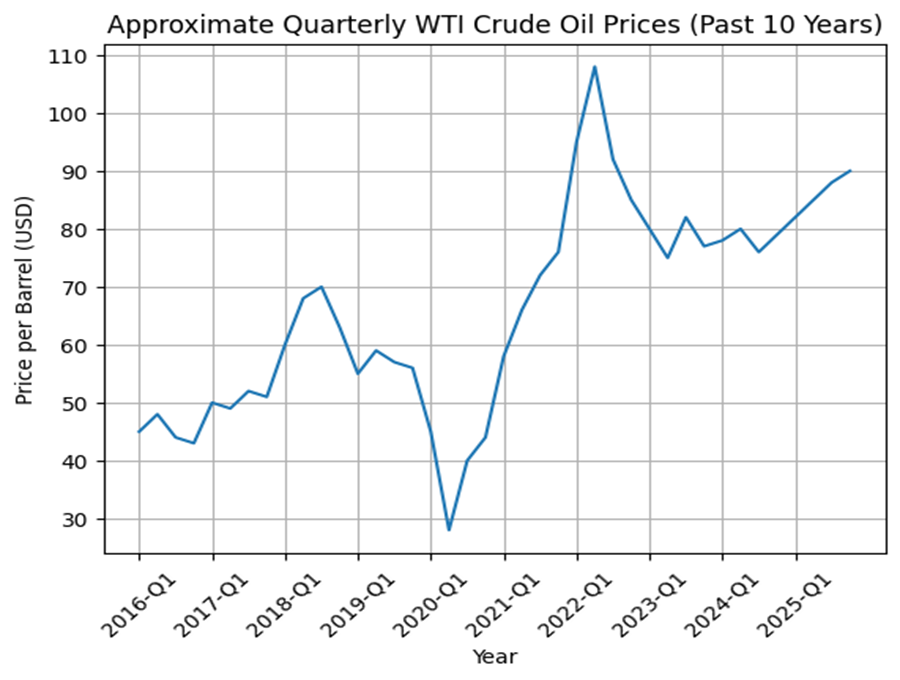
Source: U.S. Energy Information Administration (EIA), WTI Spot Price, Cushing, OK.
As the chart above illustrates, oil prices today remain within the range experienced over the past decade. Even recent increases still leave prices below some of the highs reached during earlier periods, particularly during the 2022 energy price spike largely attributed to the Russian invasion of Ukraine.
Equity Markets and Geopolitical Conflict
Equity markets have historically experienced short‑term declines following geopolitical events. However, these declines are often temporary and tend to stabilize once uncertainty begins to fade.
History shows that markets often react negatively at first, but recover as investors gain clarity about the economic implications of the event.
The Challenge of Market Timing
When headlines feel overwhelming, it can be tempting to move investments into cash until things settle down. Unfortunately, history suggests that attempting to time the market can be extremely difficult and often counterproductive.
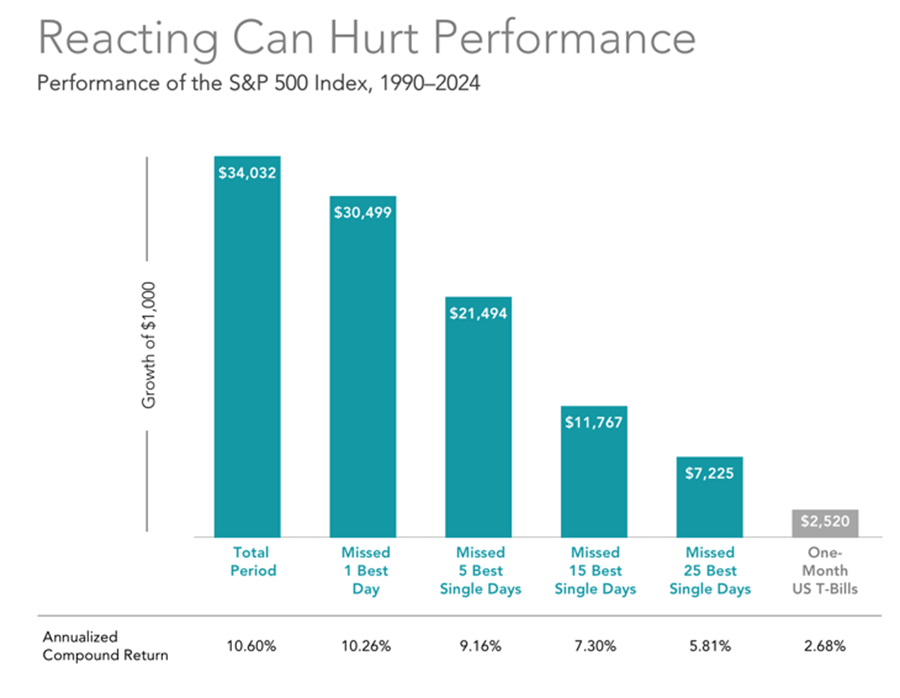
Source: Dimensional Fund Advisors
Many of the market’s strongest days occur during periods of high volatility. Investors who move to the sidelines often miss these powerful rebounds.
Extreme Declines Are Often Followed by Strong Recoveries
The COVID‑19 market crash provides a powerful example of how quickly markets can recover after severe declines.
In early 2020 the market declined roughly 34% in just over a month as global economies shut down. Yet only months later the market had recovered those losses. Investors who remained disciplined and stayed invested were able to participate in that rebound.
Tuning Out the Noise
Financial media thrives on dramatic narratives, particularly during periods of war and geopolitical uncertainty. Commentary often focuses on the most alarming possible outcomes. (For example, you do not need to look too hard to find an article declaring the start of World War III.) While these scenarios are worth monitoring, they can also create a tremendous amount of noise for long‑term investors.
A helpful discipline during these moments is learning to tune out much of the day‑to‑day commentary and instead focus on longer‑term trends. Markets have historically proven remarkably resilient in the face of geopolitical shocks. Short‑term volatility may increase, but long‑term investment outcomes are rarely determined by a single headline.
The Role of a Financial Plan
A well‑constructed financial plan assumes that market downturns will occur periodically. Diversification across asset classes, maintaining appropriate liquidity, and aligning portfolios with long‑term goals are key components of navigating volatility.
For this reason, the goal is not to eliminate volatility but rather to ensure that temporary market declines do not derail long‑term financial objectives.
Final Thoughts
Geopolitical events like the current Iran conflict can create unsettling headlines and short‑term market fluctuations. However, history consistently shows that disciplined, long‑term investors who remain focused on their financial plans are often best positioned to navigate these periods successfully.
If recent market developments have raised questions about your portfolio or your financial plan, we encourage you to reach out to your team at WRFA. A conversation about your investment strategy and long‑term goals can often provide clarity and reassurance during uncertain times.
Disclosure: The information provided in this blog post is for educational and informational purposes only and should not be construed as financial advice. While we strive to present accurate and up-to-date information, the financial, tax, and legal landscape is subject to change, and individual circumstances vary. Readers are encouraged to consult with a qualified financial advisor or professional before making any financial decisions or implementing strategies discussed in this post. Our firm does not guarantee the accuracy, completeness, or suitability of the information provided, and we disclaim any liability for any direct or indirect damages arising from the use of this information. Artificial Intelligence was used to assist in the writing of this article. Past performance is not indicative of future results. Any investment involves risk, and individuals should carefully consider their financial situation and risk tolerance before making any investment decisions.